HypoPose
Template-Guided Geometric Hypothesis Modeling for Training-Free Unseen 6D Pose Estimation
ACM Multimedia 2026 · Accepted
From a single RGB image and CAD-rendered templates, HypoPose estimates an unseen object’s 3D position and 3D orientation without object-specific training or fine-tuning.
Motivation
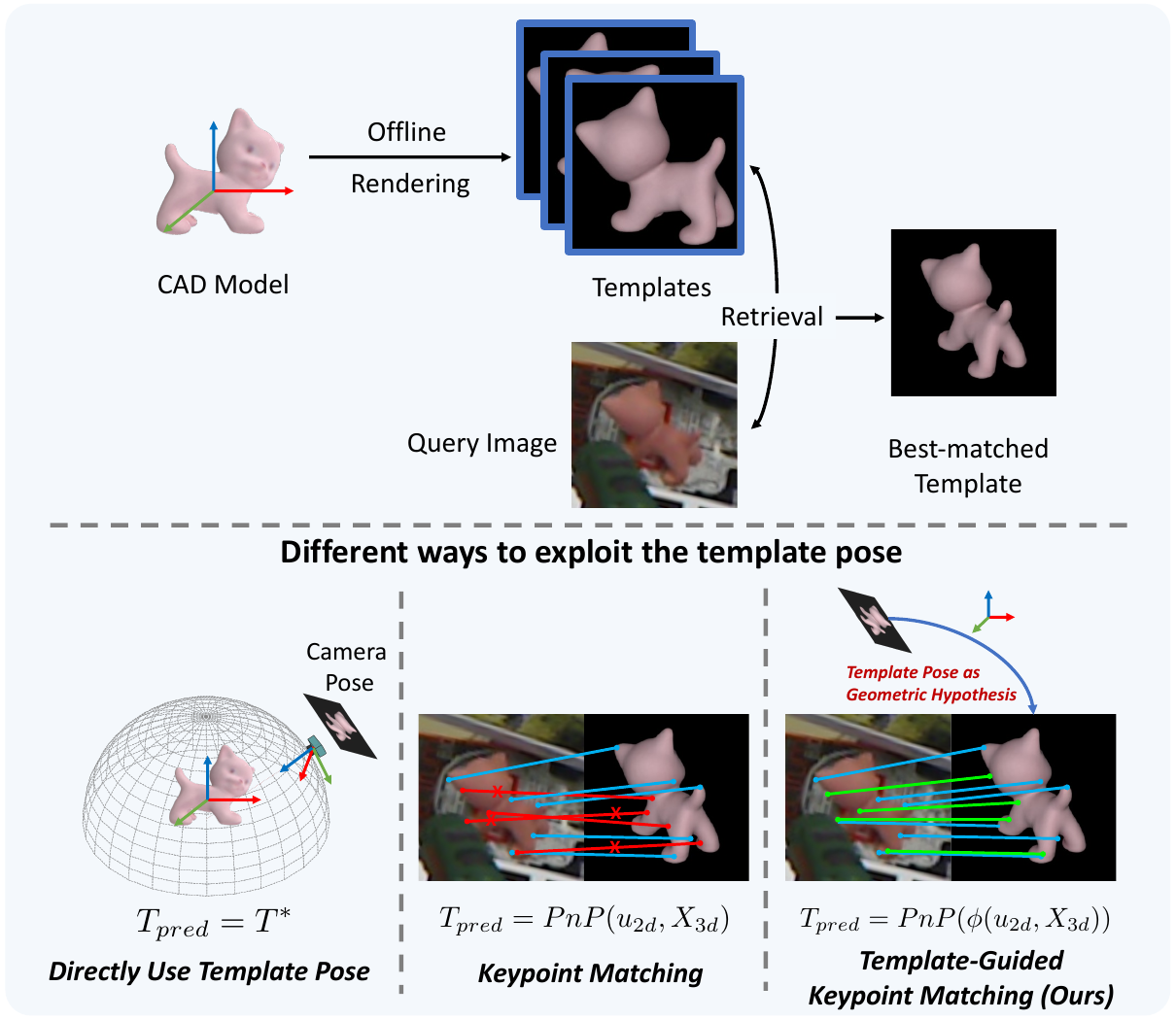
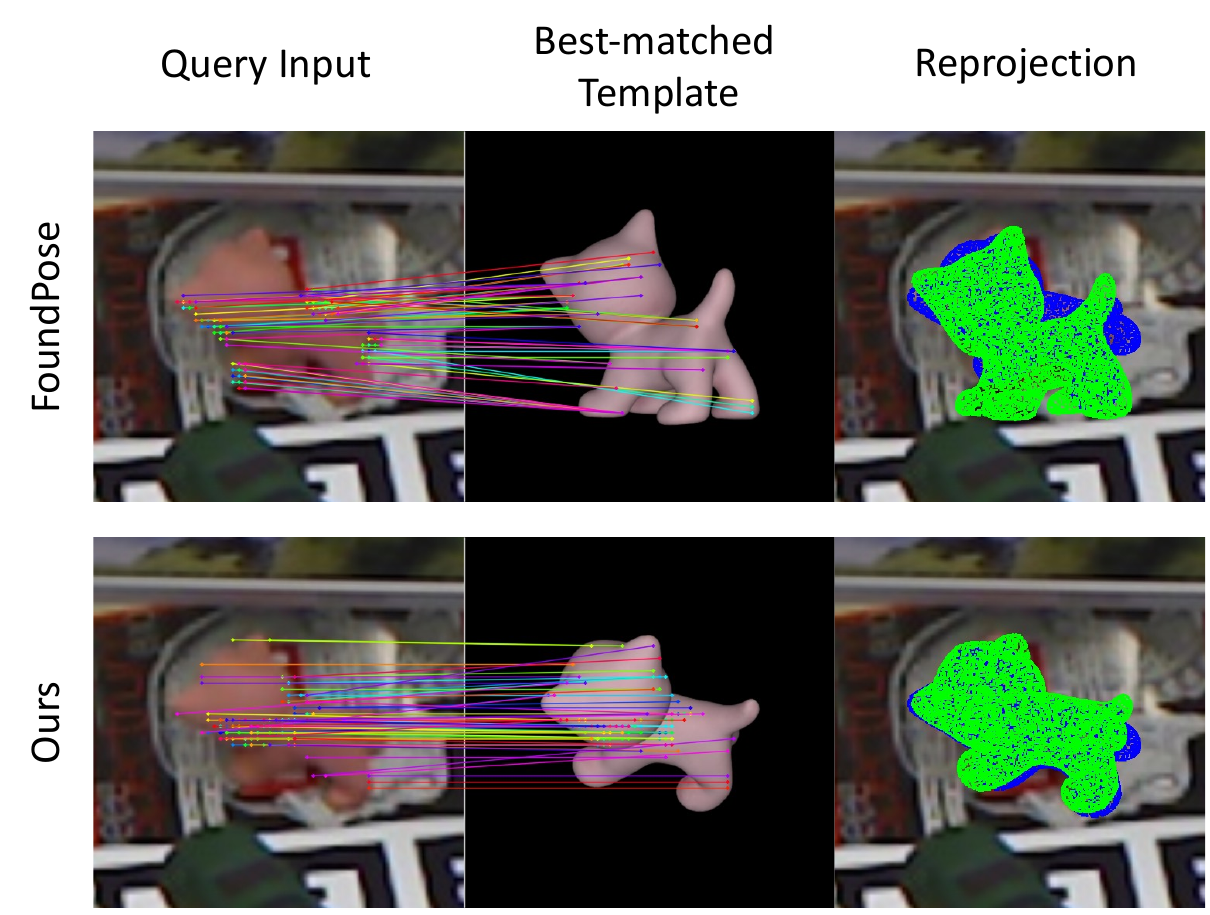
Pretrained visual features make it possible to match a new object to CAD-rendered views without retraining. But appearance alone can confuse similar-looking regions, especially under symmetry, occlusion, or large viewpoint changes.
Each rendered template also has a known pose. HypoPose uses this pose as a geometric hypothesis to guide which image points should match which 3D model points, then checks and combines matches across several hypotheses.
How it works
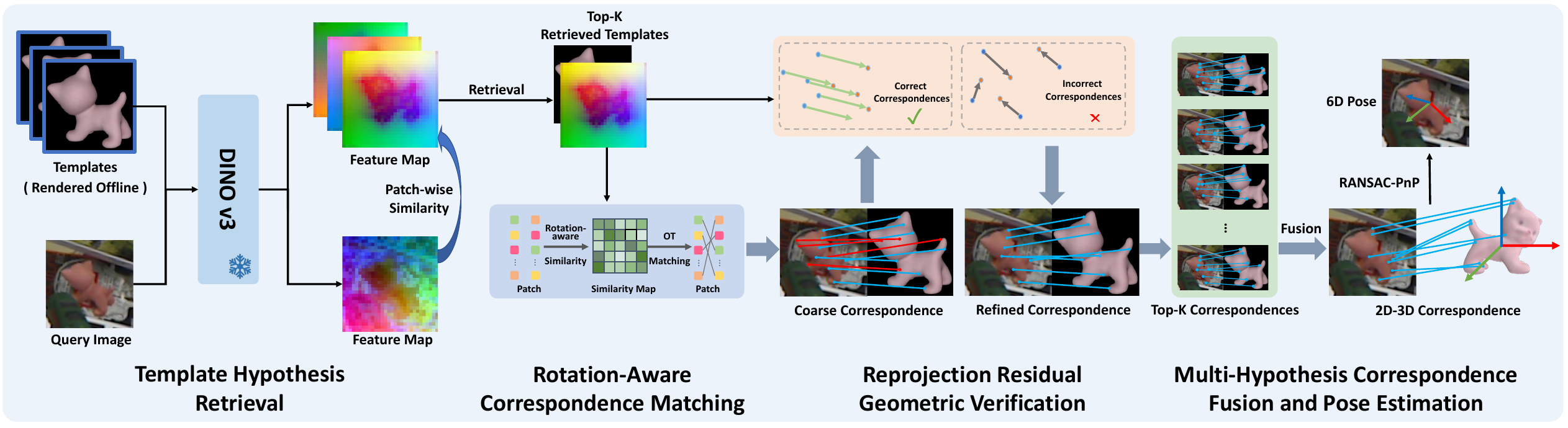
The method uses a query RGB image, an object mask, camera intrinsics, and a template library rendered from the target object’s CAD model. No depth measurement of the query scene is required. The pretrained DINOv3 backbone stays frozen.
Retrieve hypotheses
Compare image patches with rendered templates and retain five candidate views. Each template’s known rotation provides a coarse geometric cue.
Match with geometry
Combine visual similarity with the rotation cue, then use optimal transport to find globally consistent matches while allowing points to remain unmatched.
Verify, fuse, and solve
Filter matches by their centered reprojection residuals, combine 3D matches through consensus across templates, and solve the final pose with RANSAC-PnP.
Results
Unseen objects. On seven BOP datasets, HypoPose reaches 46.2% Average Recall, compared with 37.2% for FoundPose and 39.5% for Pos3R. These are full-pipeline results without pose refinement.
Training-free RGB methods · Average Recall (%) · higher is better. Bold marks the highest score in each row. On narrow screens, scroll horizontally to view all methods.
| Dataset | HypoPose | FoundPose | Pos3R |
|---|---|---|---|
| LM-O | 47.8 | 39.6 | 32.3 |
| T-LESS | 42.1 | 33.8 | 31.5 |
| TUD-L | 59.8 | 46.7 | 47.3 |
| IC-BIN | 33.5 | 23.9 | 33.1 |
| ITODD | 27.4 | 20.4 | 25.1 |
| HB | 60.4 | 50.8 | 53.7 |
| YCB-Video | 52.7 | 45.2 | 53.9 |
| Mean | 46.2 | 37.2 | 39.5 |
AR averages recall across the BOP visible-surface, 3D surface, and 2D projection error criteria and their thresholds. Values are reported in the paper’s Table 1; the compared pipelines use different pretrained backbones.
Closer look: matching quality and ablations
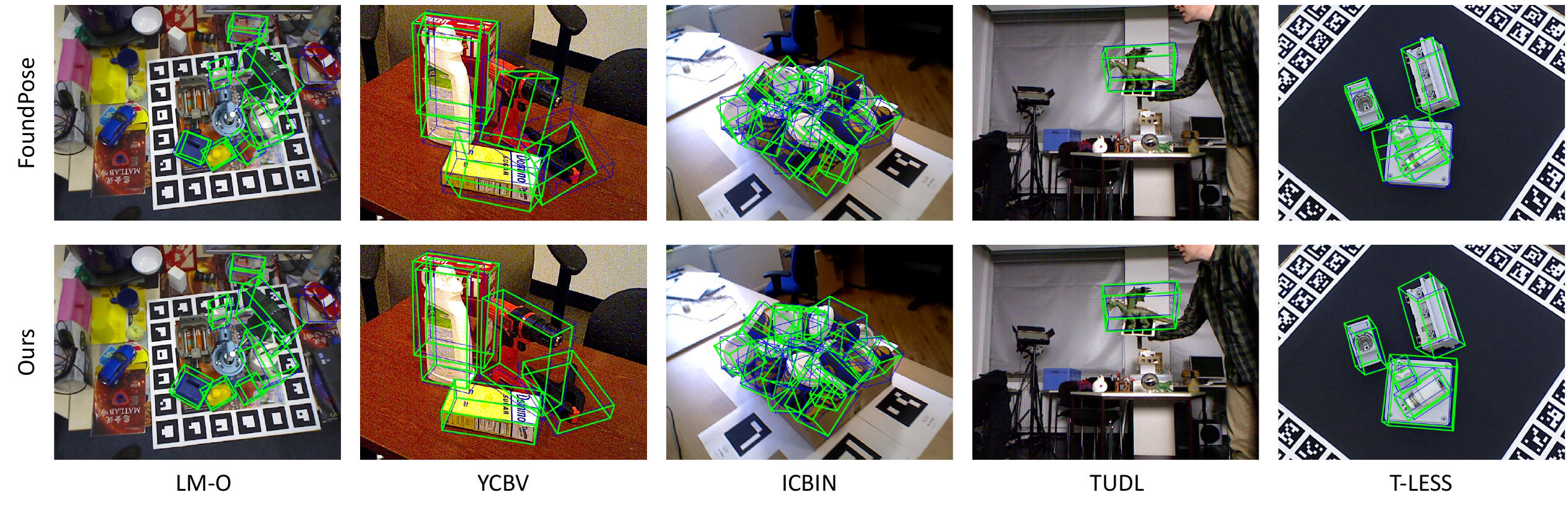
A stronger backbone contributes to the gain: replacing DINOv2 with DINOv3 raises the FoundPose-style baseline from 37.2 to 41.4 mean AR. On the DINOv3 + patch retrieval + optimal transport baseline, adding rotation-aware similarity and geometric verification improves mean AR from 43.2 to 45.9; cross-template fusion then reaches 46.2.
Runtime. The paper reports an average of 0.9 seconds per image on one RTX 4090, compared with 1.5 seconds for FoundPose on the same device. Template rendering happens offline.
Real-world examples
A qualitative demo uses four tabletop objects: a stapler, mini barrel, cup, and mouse. Templates come from CAD models captured with Reality Composer; query images come from a smartphone and are segmented with SAM.
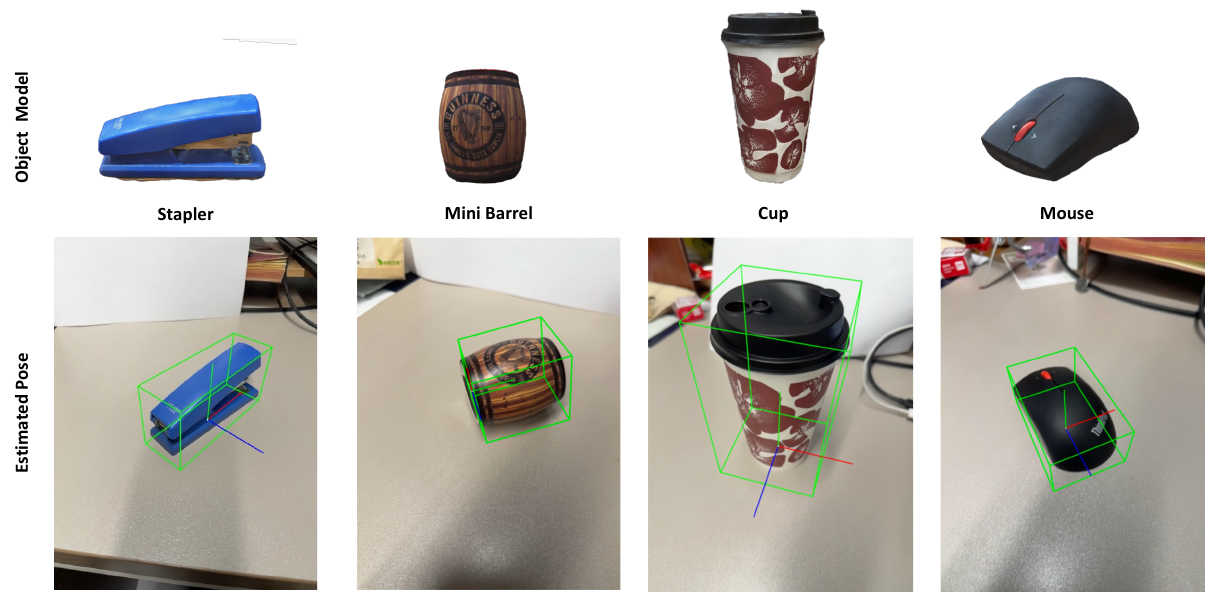
Extreme occlusion and inaccurate object masks can still cause errors in retrieval and correspondence matching.
Figures and results are from the HypoPose paper, ACM Multimedia 2026.